
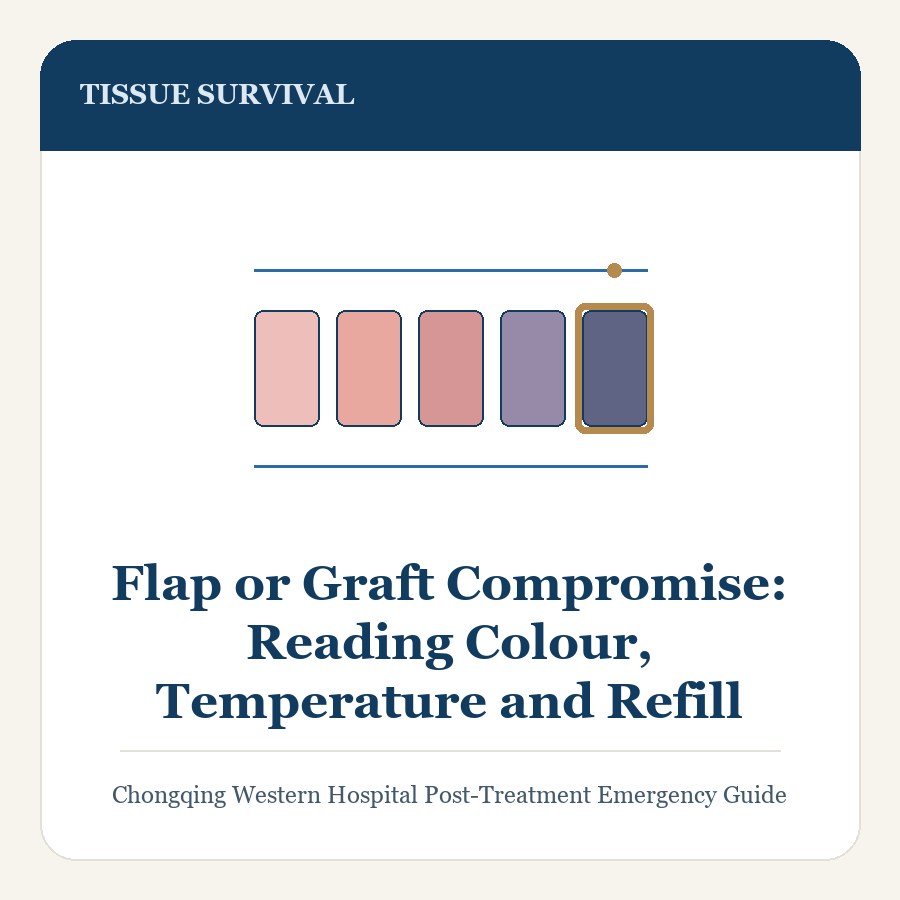
In short. How to read the signs that a flap or skin graft is losing its blood supply, what the narrow salvage window means, and why a change noticed early can often be reversed.
Key points
- Many flaps under stress recover once the cause is removed: pressure relieved, a tight dressing loosened, a collection drained, a spasm treated.
- That is exactly why the window matters.
- Tissue that has not yet died can be saved; tissue that has already died cannot be brought back, and will need to be removed later.
A flap is a block of tissue moved with its own blood supply; a graft is tissue moved without one, dependent on the bed beneath it growing new vessels. Both depend on a blood supply that can be interrupted by pressure, tension, kinking, a collection of blood beneath, infection or a clot. When perfusion fails, the tissue changes in ways that are visible from the outside, and those changes are the signal to act, because a compromised flap can often be salvaged if it is seen early.
What a healthy flap or graft looks like
Healthy tissue is warm to the touch, and its colour sits close to the surrounding skin, pink or matching the patient's own complexion. When it is pressed firmly with a fingertip for a second or two and released, the colour returns within a short time. This is capillary refill. A healthy flap may look slightly pale or congested during the first day and then improve.
The signs of compromise
Colour that turns pale and white, or dusky, blue-grey or mottled. Skin that feels cool compared with the tissue around it, or cold. Capillary refill that is very slow, or that does not happen at all after the pressure is released. A flap that becomes tense and shiny. A graft that lifts away or develops a collection of fluid beneath it. Pain that increases. Any of these appearing or worsening in the hours after an operation is significant.
Compromise is not always failure
Many flaps under stress recover once the cause is removed: pressure relieved, a tight dressing loosened, a collection drained, a spasm treated. That is exactly why the window matters. Tissue that has not yet died can be saved; tissue that has already died cannot be brought back, and will need to be removed later.
What to do while help is arranged
Do not press repeatedly on the area to check it, and do not apply heat, ice or any ointment. Do not adjust or remove dressings yourself, and do not sleep on the flap. Elevate the area if you have been told to, keep it warm generally, and stop smoking, because nicotine narrows blood vessels and is one of the few things a patient can control that measurably affects flap survival. Make contact immediately and describe the colour and the temperature.
Emergency action
- Contact your treating team immediately if a flap or graft looks pale, dusky, mottled or blue-grey, or feels cold compared with the skin around it.
- If the team cannot be reached, call the hospital main line or attend the nearest emergency department — do not wait for a scheduled dressing appointment.
- Do not apply heat or ice, do not release or change the dressings yourself, and do not smoke.
Frequently asked questions
What does a healthy flap or graft look like?
Healthy tissue is warm to the touch and its colour sits close to the surrounding skin, pink or matching your own complexion. When it is pressed firmly with a fingertip for a second or two and released, the colour returns within a short time. A healthy flap may look slightly pale or congested on the first day, then improve.
Which changes mean the flap or graft is losing its blood supply?
Colour turning pale and white, or dusky, blue-grey or mottled; skin that feels cool or cold compared with the tissue around it; capillary refill that is very slow or absent; a flap that becomes tense and shiny; or pain that increases. Do not apply heat or ice, and contact your treating team immediately.
Why is it worth reporting a colour change so quickly?
Because many flaps under stress recover once the cause is removed: pressure relieved, a tight dressing loosened, a collection drained, a spasm treated. Tissue that has not yet died can be saved; tissue that has already died cannot be brought back. Until it is reviewed, do not smoke, because nicotine narrows blood vessels.
Risks & Limitations
- Most recoveries are uneventful, but a minority of complications are time-critical and are measured in hours rather than days.
- Delay is the main factor that turns a treatable problem into a permanent one, which is why this guide asks you to make contact early rather than to wait and see.
- This guide cannot replace an in-person assessment. It describes general warning signs, not your own case, and it cannot tell you what is happening in your tissue.
- Your own treating team's aftercare instructions take precedence over anything written here. If they differ from this guide, follow your team.
- Some complications described here are rare. Reading about them is not a reason to expect them, and it is not a substitute for asking your team what specifically to watch for.
When to Seek Care
- Difficulty breathing, chest pain, or a swollen and painful calf — call emergency services or attend the nearest emergency department immediately.
- Sudden change or loss of vision — attend the nearest emergency department immediately, and say what procedure you had.
- Severe pain out of proportion to the procedure, or skin turning white, grey, mottled or dusky after an injectable.
- Uncontrolled bleeding, or a flap or graft turning dark or cold.
- Fever, spreading redness, pus or foul-smelling discharge from a wound, or a wound that is opening — contact your treating team the same day, or the hospital main line if the team cannot be reached.
References & Further Reading
- World Health Organization (WHO) — patient safety and emergency care resources
- National Institute for Health and Care Excellence (NICE, UK) — relevant clinical guidance
- American Society of Plastic Surgeons (ASPS) — procedure and safety guidance
- Resuscitation Council — basic life support and emergency response guidance
This page is patient education, not medical advice, and it does not cite individual studies. It cannot diagnose your situation and it does not replace an examination. In an emergency, call emergency services or attend the nearest emergency department. To contact the team at Chongqing West District Hospital, see Contact & Emergency Guidance.